


Children’s Book Word Counts by Age Group
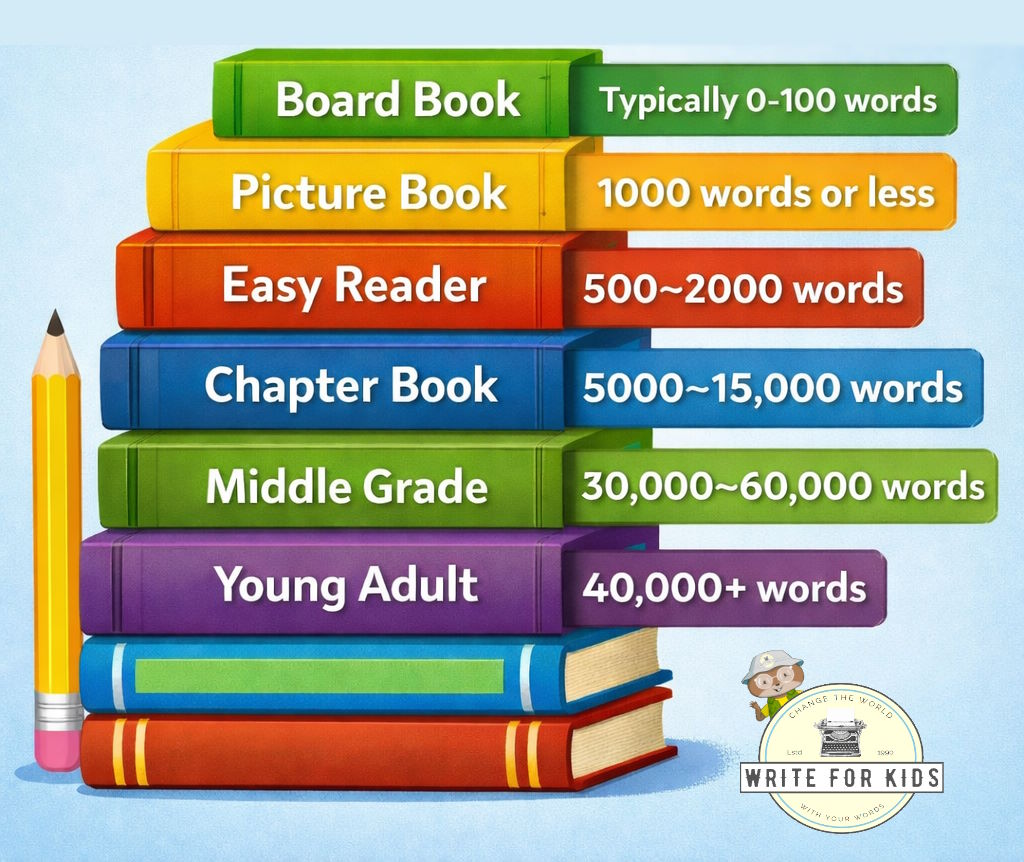
How long should a children’s book be? It depends on the reader’s age and the kind of book you’re writing.
As a quick guideline, picture books are usually 1,000 words or fewer, early readers about 500–2,000 words, chapter books about 5,000–15,000 words, middle grade novels about 30,000–60,000 words, and young adult novels generally start around 40,000 words.
These are market guidelines, not unbreakable rules. Genre, format, subject, reading level and an individual publisher’s needs can all affect the ideal length. But if you hope to submit your manuscript to agents or traditional publishers, knowing the normal range for your category helps you avoid an immediate mismatch.
These guidelines exist because reading ability, attention span and storytelling complexity change as children grow. A four-year-old listening to a picture book needs a very different reading experience than a twelve-year-old reading a middle grade novel independently.
If you’re just getting started, our complete guide to writing a children’s book walks through the process from idea to finished manuscript.
Children’s Book Word Count Chart
| Book category | Typical reader age | Typical word count |
|---|---|---|
| Board book | 0–3 | 0–100 words |
| Picture book | 3–8 | 300–800 words is common; generally 1,000 or fewer |
| Early reader | 5–8 | About 500–2,000 words |
| Transitional or chapter book | 6–10 | About 5,000–15,000 words |
| Middle grade novel | 8–12 | About 30,000–60,000 words |
| Young adult novel | 12 and up | Generally 40,000 words and up; many novels are substantially longer |
Use this chart as a starting point. Always check the current submission guidelines of a particular agent or publisher before submitting.
Board Book Word Counts
Typical age: Babies and toddlers, approximately 0–3
Typical length: 0–100 words
Board books rely heavily on illustrations and use very simple language, often with only a few words on each page. Concepts such as colors, animals, numbers, routines and familiar objects are common. Rhythm, repetition and opportunities for interaction often matter more than plot complexity.
Picture Book Word Counts
Typical age: Approximately 3–8
Typical length: Usually 1,000 words or fewer; 300–800 words is common
Picture books are designed to be read aloud, and most are 32 pages long. The illustrations carry part of the storytelling, so the manuscript does not need to describe everything the reader will see.
Fiction picture books usually focus on a central character, a clear problem and a satisfying ending. Picture-book nonfiction may explain a subject directly or use a narrative approach, as many picture-book biographies do.
Learn more about writing picture books.
Early Reader Word Counts
Typical age: Kindergarten through second or third grade
Typical length: About 500–2,000 words
Early readers—sometimes called easy readers—are written for children learning to read independently. They are commonly 32–64 pages long and may be fiction or nonfiction.
The books are often assigned reading levels. The simplest levels use shorter sentences, more repetition and a very limited vocabulary. Higher levels may include longer stories and short chapters. Because publishers use different leveling systems, study the requirements of the publisher or series you plan to approach.
Learn more about writing early readers.
Chapter Book Word Counts
Typical age: Approximately 6–10
Typical length: About 5,000–15,000 words
Chapter books bridge the gap between early readers and middle grade novels. They are divided into short chapters, commonly three to five pages each, and are often 64–96 pages long.
Books for younger readers—sometimes called transitional books—fall toward the shorter end of the range. More advanced chapter books can use longer plots, a larger cast and more complex language, while still providing a manageable reading experience.
Learn more about writing chapter books.
Middle Grade Novel Word Counts
Typical age: Approximately 8–12, sometimes extending to 14
Typical length: About 30,000–60,000 words
Middle grade novels are written for children who are reading independently. The protagonist is usually close to the age of the intended reader, and the central conflict should matter to a child or young teen.
Middle grade can include contemporary stories, mysteries, historical fiction, fantasy, science fiction and other genres. Fantasy and other stories requiring extensive worldbuilding may run longer than realistic fiction. Illustrated nonfiction and novels in verse may contain fewer words.
Learn more about writing middle grade novels.
Young Adult Novel Word Counts
Typical age: Approximately 12 and up
Typical length: Generally 40,000 words and up
Young adult novels are written primarily for teen readers, although many adults read them too. Length varies considerably by genre. Contemporary stories may be relatively concise, while fantasy, science fiction and historical novels often need more room for worldbuilding and plot.
For a first-time author, an unusually long manuscript may be harder to place because it costs more to edit, design, print and distribute. If your manuscript is far outside the normal range for its category, make sure the story truly requires that length.
Learn more about writing YA and young adult novels.
Do Children’s Book Word Counts Include the Title?
Usually, the manuscript word count refers to the story text itself. A title page, your contact information and illustration notes generally are not included. When submitting, follow the agent’s or publisher’s instructions if they specify a different method.
Do Illustration Notes Count Toward the Word Count?
Illustration notes are generally not part of the story’s word count. Use them sparingly and only when the illustrator needs information that is essential but not apparent from the text—for example, when the joke depends on the picture contradicting the words.
Is It Okay to Be Outside the Typical Range?
Yes—but understand what the range tells you. A word count far above or below the norm may indicate that the manuscript is aimed at the wrong age group, contains too much explanation, or needs more development.
An exceptional book can break a convention. A new writer, however, should know why the convention exists and have a strong story-based reason for departing from it.
Should You Choose the Age Group Before Writing?
You should have a likely reader in mind before drafting. The reader’s age affects vocabulary, sentence length, subject matter, plot complexity, character age and manuscript length.
If you have already written the manuscript, use the chart above as a diagnostic tool. Compare its word count, protagonist’s age, reading difficulty and story concerns with the category you believe you have written.
What to Do if Your Manuscript Is Too Long
Look for scenes that repeat information, unnecessary setup, lengthy description, too many secondary characters and dialogue that does not move the story forward. In a picture book, also remove descriptions of things the illustrations can communicate.
Do not cut merely to reach a number. The goal is to make every word serve the reader and the story.
Next Steps After Choosing Your Word Count
Once you know the right length for your children’s book, the next step is shaping your idea into a strong story. Start with the guide that best matches where you are right now:
- I’m Just Starting: Get Started Writing Children’s Books
- I’m Stuck: Get Help With Your Children’s Writing
- I’ve Finished a Draft: Revise Your Children’s Book Manuscript
- I’m Ready to Get Published: How to Publish a Children’s Book